Most organisations design change as a planning problem. The real challenge is a political one.
Strategy begins before anyone decides it has begun. Andrew Pettigrew made this point with a deceptively simple observation: the moment someone raises a problem, the strategy process is already underway. Behaviour precedes intention. The question is not whether change is happening but whether anyone has noticed — and whether the people who notice are treated as diagnosticians or as the problem itself. This is the gap most organisations fall into. They mistake the surfacing of tension for its creation.
Pettigrew’s framing runs counter to the dominant planning model. Strategy is not a rational sequence from analysis to execution. It is simultaneously a change process, an influence process, and a political process. The political dimension is the one that organisations are least willing to name. Every change redistributes resources. Some people gain power; others lose it. The individuals who resist are rarely irrational — they are responding accurately to a shifting incentive landscape. Pretending otherwise is how change programmes stall in year two.
Context is the overlooked variable
The framework Pettigrew built — context, content, process, time — places an unusual emphasis on where change happens rather than what change looks like. Inner context is the organisational reality: structures, culture, and political norms. Outer context is the environment pressing in. Most change efforts over-index on content, the “what,” while under-investing in understanding the context that will either accelerate or suffocate it. As Pettigrew put it, dealing with what is harder than dealing with how. The how is a design problem. What forces you to confront competing interests, legacy systems, and the emotional weight of unlearning?
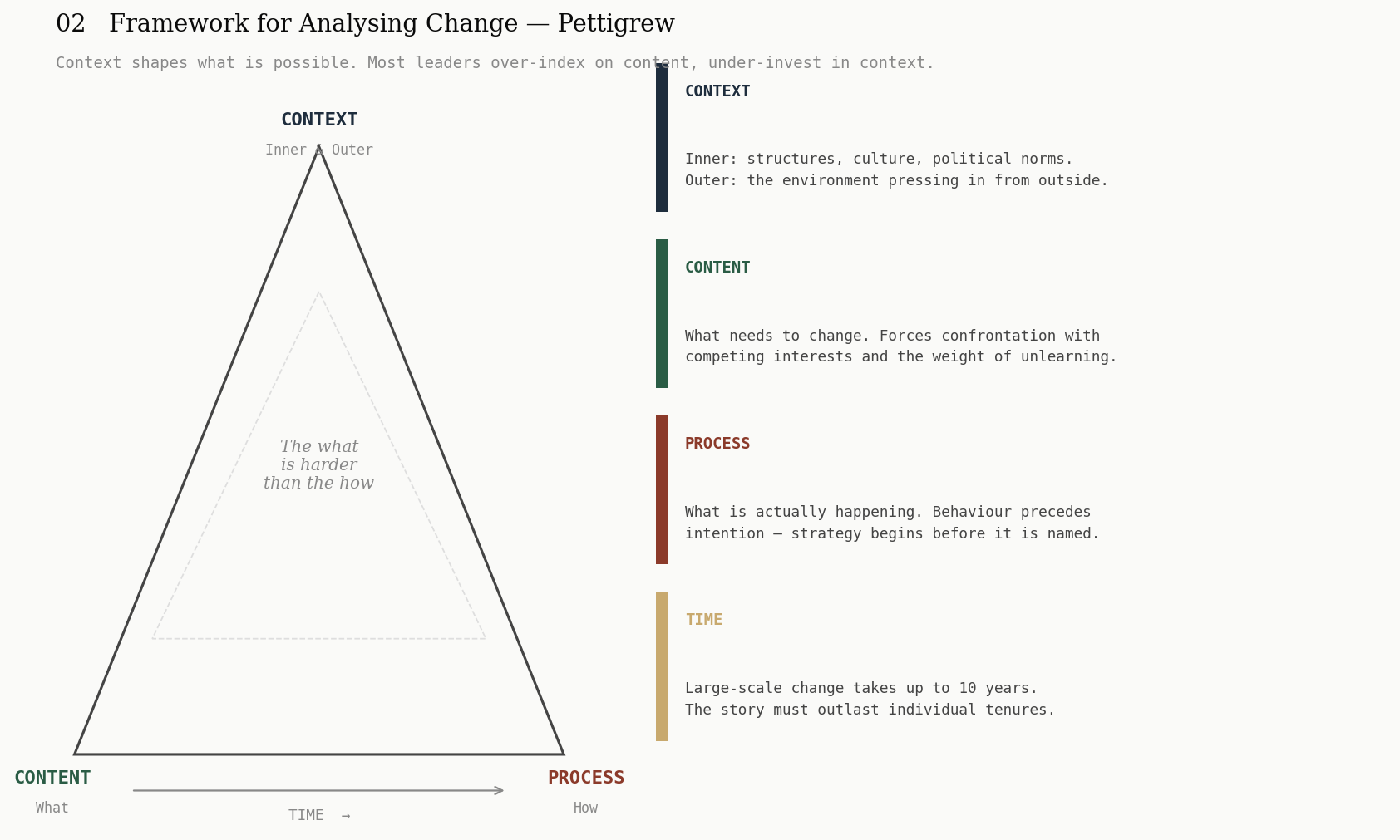
FIG. 02 — Pettigrew’s framework for analysing change. Context, content, and process unfold across time. Most change efforts over-index on content while neglecting the context that will either accelerate or suffocate it.
Crisis simplifies this. When survival is at stake, mobilisation becomes easier because the case for change is self-evident. But crisis-driven change has a structural weakness: it depends on a shared belief that the crisis is real. If that belief is unevenly distributed, the energy fractures. And if no crisis exists, leaders must manufacture urgency — a move that works precisely once before it erodes trust.
The political learning loop
Change is not a single event but a learning process with a recognisable arc: sense, concern, understand, plan, act. Each phase is vulnerable to regression. Energy dissipates. Political resistance consolidates. The J-curve — where performance dips before it rises — is the period when most change efforts are quietly abandoned, not because they failed, but because the organisation lost patience with the transition costs.
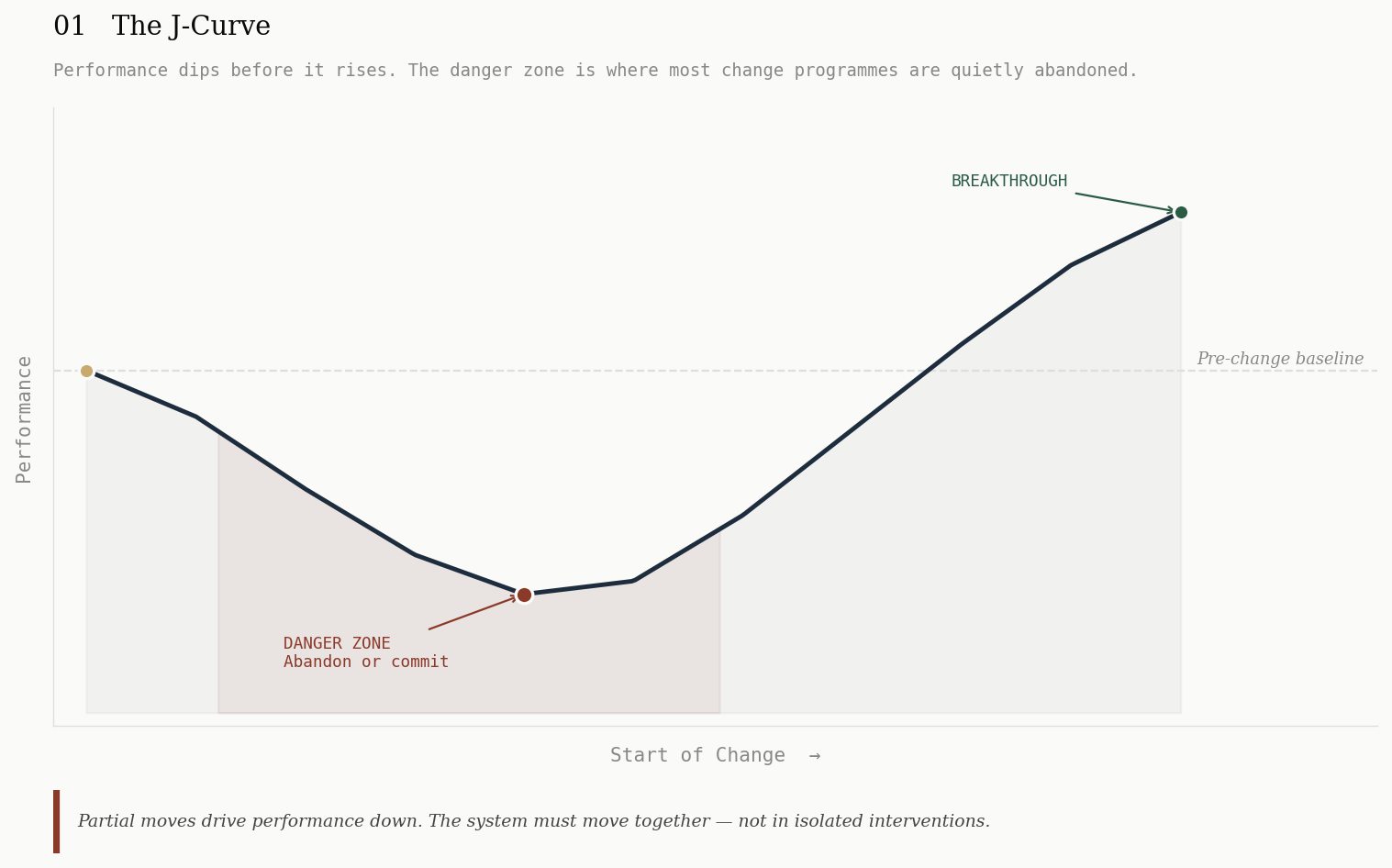
FIG. 01 — Performance trajectory across a change programme. The danger zone is where most change efforts are quietly abandoned — because the organisation lost patience with the transition cost rather than failure.
Partial moves drive down performance. This is the insight most change sponsors ignore. Thinking in systems means committing to sets of changes, not isolated interventions. When leaders implement one piece of a broader transformation and wait to see results, they create the very dip they were trying to avoid. The system needs to move together, which requires what Joseph Nye would call contextual intelligence — the judgment to read the environment and calibrate the type of power being applied.
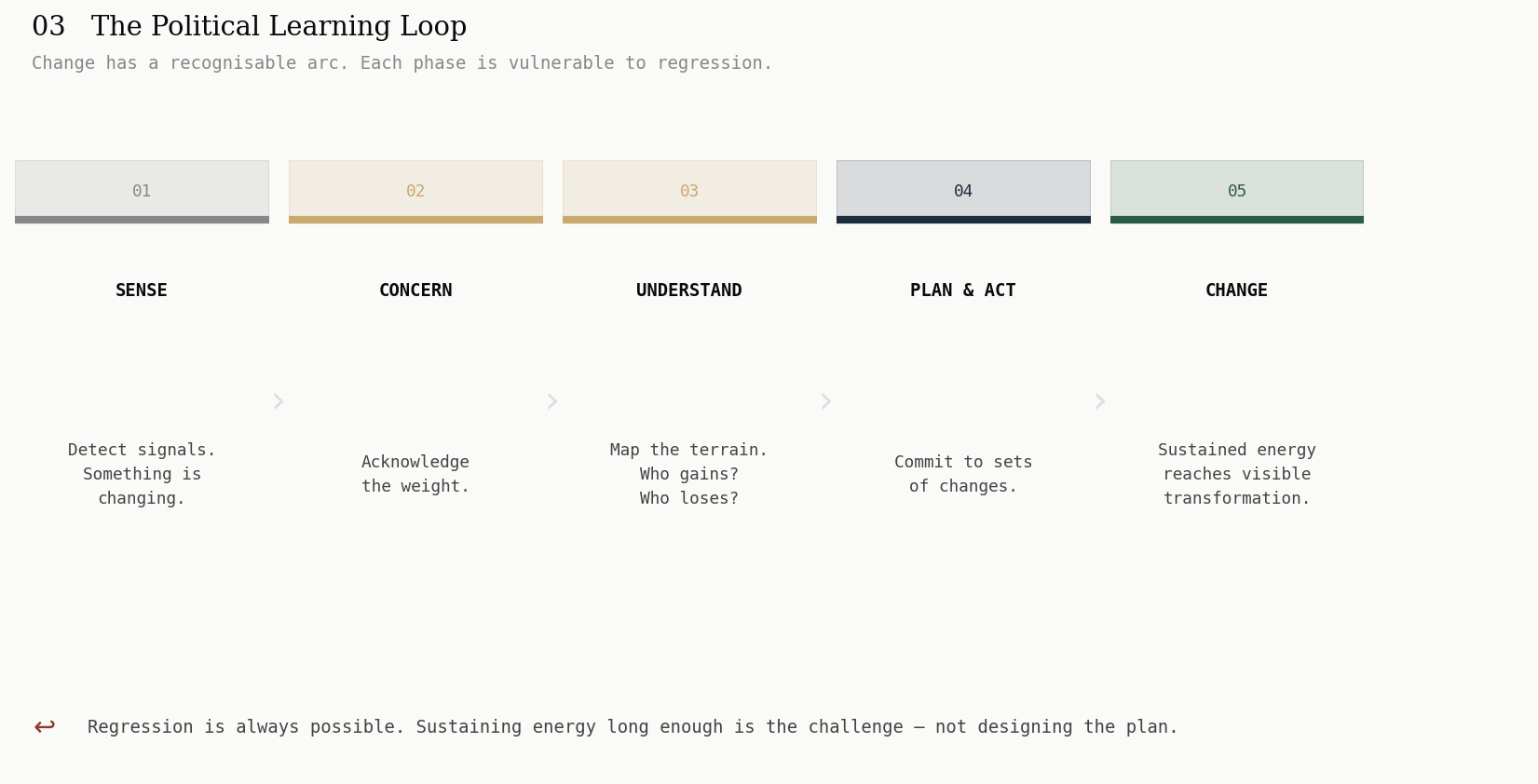
FIG. 03 — The five-phase arc of organisational change. Each phase is vulnerable to regression. Knowing where you are in the process is critical.
The directional story
Pettigrew’s most practical insight may be the simplest. Change requires a directional story with one foot in the present and one in the future. Not a vision statement. Not an aspirational slide deck. A story that acknowledges where the organisation actually is while making the destination concrete enough to sustain effort across what can be a decade-long process.
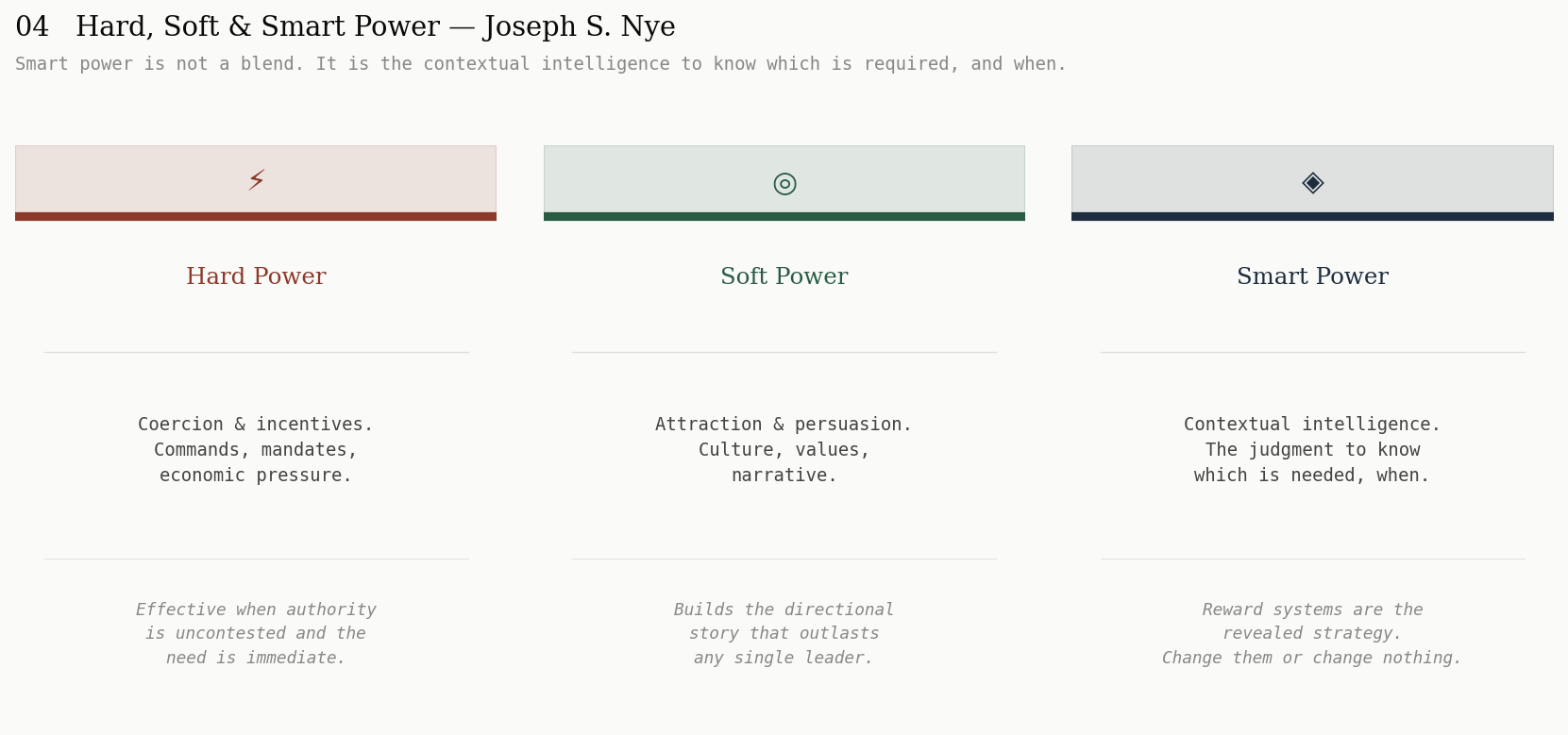
FIG. 04 — Joseph S. Nye’s power typology applied to organisational change. Smart power is not a blend of hard and soft — it is the contextual intelligence to know what the moment demands.
This is where leadership becomes non-negotiable. Intergenerational leadership change — the reality that large-scale transformation outlasts individual tenures — means the story must be transferable. It cannot live in one leader’s charisma. It must be embedded in measurement systems, recognition structures, and the cultural norms that signal which behaviour actually matters. McKinsey’s point about clarifying behaviour lands here: reward systems are the revealed strategy of an organisation. If they do not change, nothing else does.
The organisations that succeed at sustained change are not the ones with the best plans. They are the ones who understand change as a political arena, manage expectations through the inevitable performance dip, and build measurement systems that make progress visible before the final results arrive. Smart power, as Nye defined it, is not hard or soft. It is the judgment to know which context demands which response. The same is true of organisational change.
The skill is not in designing the change. It is in reading the room long enough to let it land.